
History (updated 2026)
A BRIEF HISTORY
OF THE VILLAGE OF KIRTLAND HILLS
Originally Compiled – April 30, 1988
Updated by the Kirtland Hills Community Activities Committee – May, 1990
(Revised September, 1994)
(Revised February, 2011)
Updated by the Kirtland Hills Centennial Committee – May 2026
Introduction
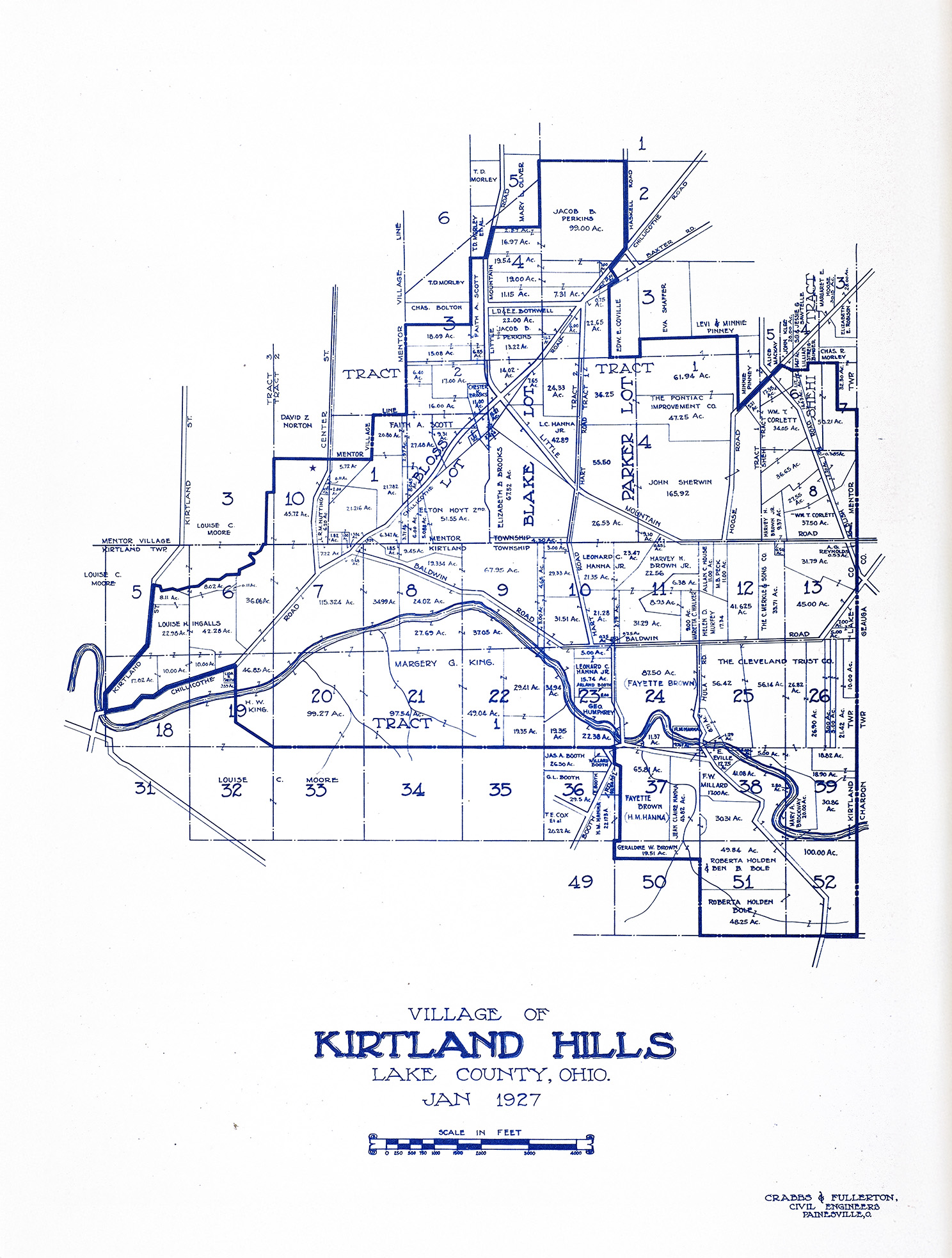
The Village of Kirtland Hills has a varied and interesting history, spanning from pre-historic times, early settlement, and later, the formation of the Village in 1926. Over the course of time, the village’s wild, natural beauty has been a constant. Situated near Little Mountain in an area shaped by glaciers over 12,000 years ago, the Village of Kirtland Hills is traversed by the East Branch of the Chagrin River and its many tributaries. The result is a rugged and captivating landscape that is largely shaped by the deep ravines, hardwood and hemlock forests, and large fields that abound within its boundaries, covering 13.5 square miles in Lake County.
The following history will explain the village’s early beginnings, including the pre-settlement period; early settlement, including on and around Little Mountain, the formation of the Village of Kirtland Hills in 1926, significant events over the last 100 years of village history, and notable locations within the village.
Early History
Lake County is rich in Native American history as many artifacts have been found in this vicinity. This was an especially good area for habitation because the rivers and streams provided food and water, fertile land supported agriculture, and abundant game in the forests meant good hunting.
Pre-historical tribes common to this area included the Paleo Tribe and that Archaic People, both of whom were transient hunting tribes, and the Adenas and Hopewells, who were Mound Builders. The Whitlesey Tribe were the last prehistoric people to inhabit this area. They built villages on bluffs above the river banks. These tribes were all wiped out by the Seneca and Iroquois Tribes when they expanded their territories into this region as they hunted for furs to trade with European settlers.
Early Settlement
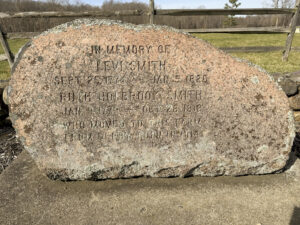
One of the earliest settlers in what was to become the Village of Kirtland Hills was Levi Smith. Born in Derby, Connecticut, in 1774, Levi was a great-grandson of Ebenezer Smith, who was an early settler of Jamaica, Long Island. He married Ruth Holbrook in 1800 and moved to his farm on Hart Road in 1814, which was at the time a part of Geauga County.
Ruth died in 1818, leaving at least four children (Daniel, George, Catherine, and Sarah). Levi then went back to Derby, where he married Rebecca Hotchkiss. They returned to the Smith Farm in the spring of 1819.
On September 3, 1819, a meeting was held at the home of Rebecca and Levi, which resulted in the organization of the First Congregational Society of Kirtland, which became the Old South Church in Kirtland. A gravestone was erected in honor of these early residents on Hart Road, near the Baldwin Road intersection. This site was renovated in 1987 and remains present today.
Blish Road Cemetery (King Memorial Road)
On the east side of King Memorial Road, about halfway between Little Mountain and I-90, was “Blish Road Cemetery.” When it was active, it served the residents of Little Mountain and, at one time, was located on what was the Verbsky Farm. It included the grave of the Honorable John Reynolds, a veteran of the Revolutionary War, members of his family, and other early settlers.
Hon. Reynolds was born in Norwich, Connecticut and enlisted in the Continental Army in the spring of 1776, serving until December 1776 in Captain Joshua Huntington’s Company, Colonel Samuel Sheldon’s Connecticut regiment. During this service, Hon. Reynolds was wounded during the Battle of Long Island when New York was abandoned. His descendants reported that Hon. Reynolds had “large, protruding ears” and during the battle, a bullet tore a large half-circle from the top of one ear.
Hon. Reynolds re-enlisted in March of 1777 for the duration of the war and served as a Sargent in Captain Jedediah Hude’s Company, Colonel John Durkee’s regiment. After the war, he lived and served as a Judge in New York State.
Hon. Reynolds moved to Mentor, Ohio in 1820 to live with his sons, Simeon and William, who had settled on Little Mountain in 1817. Reynolds Road (Route 306) was named for members of the family as some of them had farms in that area. Peppermint oil, an important and lucrative crop at the time, was produced on the Reynolds Farm.
Hon. Reynolds passed away at his residence on March 3, 1840 at age 79. His tombstone was erected in Blish Road Cemetery with the following inscription:
“In memory of John Reynolds, Esquire, Revolution Soldier who entered the army in the year 1777 and continued in the service of his country during the war. He died March 3, 1840, age 80 years. Here in this tomb beneath the sod, lies all that’s mortal of the man; Who’s soul ascended up to God to finish what he had begun.”
Hon. Reynold’s tomb was accompanied by the graves of his wives; Mary, who died in 1832 at age 70; and second wife, Polly, who died in 1837 at age 63.
When the Verbsky farm was sold, many of the burials were moved to Mentor Cemetery, including Hon. Reynolds.
Little Mountain
Little Mountain, at an elevation of 1266 feet, is the highest point above sea level in Lake County. The plateau at the summit includes more than 50 acres (about a square mile) of relatively flat land. It is shaped like a saddle that can be seen from a boat on Lake Erie.
On Little Mountain are deep caverns and interesting rock formations that earlier generations nicknamed “Devil’s Kitchen”, “Devil’s Bedroom”, and “Table Rock”. There are also many springs of cold, clear water that were used for “water cures” many years ago. Girdled Road once crossed its summit from east to west, and was the dividing line between Lake and Geauga Counties.
Before the settlers came, Native Americans felt the magic of the area. Local folklore shared that the native tribes of times past believed that Little Mountain was the home the Great Spirit, and they held solemn ceremonies in this location.
European settlers began establishing homes on Little Mountain in the early 1800’s- Asbel Messenger being the first, in 1815. Shortly after, members of the Reynolds family settled on Little Mountain. Over the next few years, more families joined them.
The popularity of Little Mountain grew as visitors rode in from Fairport and Painesville for picnics, walking the last half mile to the top. These casual visitors explored the caves and picnicked on a large flat rock called Table Rock. They also named various landmarks on Little Mountain that remain today.
This beloved summer resort became a principal source of income to the farm families that lived around Little Mountain. Farm produce and services were in demand by summer visitors. A small village gradually developed at what became known as Joice’s Corners (the corner of Little Mountain and Morley Roads). The first schoolhouse (log) at Little Mountain was constructed in 1822 and Joseph Reynolds was the first school teacher.
For more than a century, wealthy and influential families from all over the country spent their summers in residence at the various hotels that sprung up on the mountain. They reached the summit via stagecoach from Mentor. The attractions included marvelous wildflowers, such as Lady Slippers, Solomon Seal, Wintergreen, and the last forest of virgin Eastern White Pines existing west of the Allegheny Mountains.
Cleveland’s elite also came to Little Mountain. They included Jeptha Homer Wade, owner of Western Union Telegraph Company; Amasa Stone and State Senator Henry B. Payne, the railroad executives; John D. Rockefeller of Standard Oil; and Congressman (later President) James A. Garfield.
The first hotel on the summit was built and operated by Captain Simeon Reynolds in 1831. Captain Reynolds was a veteran of the War of 1812 and was the son of the Honorable John Reynolds. It was first called the Little Mountain House, and was later known as the Lakeview House. The hotel was spacious and contained the latest improvements for the time, among them an indoor bowling alley and an observation platform where guests were able to watch for boats on Lake Erie. Captain Reynolds was reportedly a huge Falstaff type man who weighed three hundred pounds and played the fiddle for dances at his tavern.
A second hotel was built by D. W. Stocking of Chardon in 1850. It was called the Stocking House and could accommodate two hundred guests. In 1872, the Little Mountain Club (comprised mainly of Cleveland businessmen) purchased the Stocking House and used it as their clubhouse for over sixty years. The building was torn down in 1941 and was the last of the four hotels to be demolished.
The third hotel, the Little Mountain Eagle, was built about 1857 by William S. Gardner. The main section of the building was thirty-four by forty-four and was three stories high. There was a twenty-five by thirty-foot two-story wing on each side. An observatory was located on the top. People taking the “water cure” boarded here. The Eagle (also known as the Gardner House) did not flourish long. After it was closed down, it became known as the “Haunted House”.
The fourth and last hotel built on the summit of Little Mountain in the late 1880’s was the Pinecrest Hotel. Built by a company headed by C. A. Avery, the Pinecrest Hotel was the most elegant and luxurious hotel built on the “mountain.” This three-story, T-shaped building was surrounded by a fourteen-foot veranda.
In the fall of 1880, Mrs. Babcock and Mrs. Carver opened a grocery store at Joice’s Corners that operated successfully into the early 1900’s.
In 1885, a white frame Methodist Church was built on the south side of Little Mountain, east of King Memorial Road. The church flourished for many years. Once the large landowners began purchasing the farms, the congregation dwindled and the church property was eventually sold. In 1933 the church was torn down.
The last schoolhouse, made of red brick, was constructed in 1885 at the corner of Little Mountain and King Memorial.
In 1892, the Rev. W.A. Leonard, the Episcopal Bishop of Ohio, offered to build a church for the Little Mountain Club if the Club would donate the land. This church occupied space on Little Mountain until 1916, until it was relocated to Salida Beach, near Lake Erie. Years later, it would find new life in Kirtland Hills as St. Hubert’s Church (more on St. Hubert’s Church will follow).
For many years the Little Mountain Post Office was operated from the schoolhouse until it was discontinued in 1907. Mail was actually addressed to the town of Little Mountain, Ohio, at that time.
Over time, the hotels and cottages of Little Mountain fell out of favor as other past-times became more popular. By 1904, the Pine Crest Hotel Company was dissolved and was sold at public auction the following year for $17,000 to E.B. Hale, trustee of the Little Mountain Club. While the intention was to reopen the hotel, it never happened, and the hotel was torn down in 1925.
In the years that followed, many families that summered at Little Mountain bought property and built homes in the area, including what would later become the Village of Kirtland Hills. Families such as the Kings, Hitchcocks, Baldwins, and Mathers owned large parcels of land in this area.
Today, much of Little Mountain is owned or protected by the Holden Arboretum, which is committed to preserving this natural area for future generations. Besides owning large portions of Little Mountain, Holden Arboretum holds conservation easements with a number of private property owners who have land bordering Holden property on Little Mountain. Holden Arboretum hosts guided hiking tours of Little Mountain several times a year.
Village of Kirtland Hills-The First Fifty Years
In 1922 Harry Wheelock King, president of the King Bridge Company, hired the office of the renowned landscape artist Frederick Law Olmsted (who designed New York’s Central Park) to develop a plan for his 600-acre Kingwood Farm, which consisted of a significant portion of what would later become the Village of Kirtland Hills. According to a survey map dated April 14th, 1922, Kingwood Farm appears to include present-day Kingwood Drive, parts of Center Street, Hunting Hills Drive, “The Field,” much of the Sanctuary Development, and areas along Baldwin and Chillicothe Roads.
In 1925, Leonard C. Hanna, Jr. requested that a decision be made on a name for the Village at a meeting held at the Union Club. The “Village of Kirtland Hills” was chosen in honor of Dr. Jared P. Kirtland, who lived from 1793-1877. Dr. Kirtland was a naturalist, malacologist, and politician who served as a probate judge and in the U.S. House of Representatives. He was also a physician and co-founder of the Cleveland Medical College, the medical department of Western Reserve College, where he taught medicine from 1844 to 1864. Dr. Kirtland also was a member of the “Ark,” an early precursor of the Cleveland Museum of Natural History. He discovered the “Kirtland Warbler,” and the Kirtland Bird Club of Northeast Ohio is named after him. His father, Turhand Kirtland, an early settler and veteran of the Revolutionary War, is the namesake of the City of Kirtland, which borders the Village of Kirtland Hills.
On August 14, 1926, residents of Kirtland and Mentor voted in favor of incorporating the Village of Kirtland Hills. Voting took place at the stables of Elton Hoyt, II, on the southeast side of Chillicothe Road. According to the reporting at the time, “[t]his section is destined to be a ‘second Bratenhal’ under the supervision of Mentor’s millionaires and near millionaires.”
A special election for the first officers was held on October 2, 1926 at Hoyt’s stable. The Village’s officers were notified of their election results by the clerk of Mentor Township and took office at their first meeting on October 8, 1929, held in an office building at the King Estate.
The Village’s first officers included Frank Millard as Mayor, Joseph Thomas as Clerk, Fayette Brown as Treasurer, and Ralph Perkins as Marshal. Councilmen included E.T. Eville, Arland Booth, Harry Wheelock King, Frank A. Scott, Chester K. Brooks, and Arthur D. Baldwin. It was at this meeting that it was reported that Mr. Hanna offered the Village the use of Riverside School at 9045 Baldwin Road as the Village Hall.
The Village made headlines in Ohio in June of 1929, as a cougar was spotted by Leo Hilobitz and Glenn Booth in the underbrush near the East Branch of the Chagrin River. The animal was described as a “grey-brown animal about four feet long, two feet high, with a tapering body” with a “long tail and yellow eyes.” Both men reportedly responded by “jumping into the water.” Mr. Hilobitz and Mr. Booth reported this sighting to Ed Grey, the superintendent of the Hanna Estate, who informed them that a farm hand had similarly reported seeing an American panther. Press commented that, “[a]nyway, the bushes are full of the beasts and until a circus reclaims the animal, if any, or somebody shoots it, the serene life of Kirtland Hills needs immediate and highly effective restoratives.”
In the early 1930’s, village entrance signs were placed at the corner of Little Mountain and King Memorial, on Booth Road, and at the intersection of Little Mountain and Johnnycake Ridge. There was a fourth sign that stood somewhere near Kingwood Farm on Chillicothe until it was stolen. A rail fence and quail were depicted in silhouette above a rectangle of wood with the caption “Entering the Village of Kirtland Hills, Named for Dr. Jared Kirtland, First Ornithologist of this Region”. Ora McFarland is believed to have made street signs for the Village at the Temple Forge on Route 306 across from the Kirtland Temple.
In 1933, Council bought its first police car in 1933 for $585. Wanting a “new Village Hall and garage buildings,” Council, in 1947, hired Hubbel & Benes to design the structures and Fellous & Rupel to construct models for Council’s inspection. Finally, in 1952, a front room of the completed garage served as Council’s meeting-place in the Village Hall’s present location. No new Village Hall was built.
In 1955, Governor Frank Lausche’s office released re-drawn and proposed maps of the “North-South Pike” which eventually became Interstate 90 (I-90). This proposal would eventually cut across Kirtland Hills. At the hearing in Columbus on October 17th, 1955, Deputy Lake County Engineer Jess Woods commented “As far as I can see, the lines seem to be in about the best place they could put it.” At a 1957 Council meeting, Councilman Raymond F. Evans stated that the turnpike (I-90) “will ruin the character of the village.” It was also pointed out that the route was originally planned to lie south of Little Mountain Road, in Geauga County.
In 1969, Council established an Architectural Board to review and make recommendations for future construction within the Village, in order to “preserve it as a desirable place to reside”. Urban Research and Planning, Inc. was hired by the Mayor in 1973 to prepare a comprehensive plan for zoning.
In 1972, Mrs. John Butler and Mrs. Elton Hoyt, III took it upon themselves to decorate the Village street signs for Christmas, a tradition that is continued today by the Service Department.
The Village of Kirtland Hills- The Second Fifty Years
In 1993 a Chater Commission comprised of Village residents developed the Village Charter which was approved by the voters. On January 1, 1994, the Village adopted its current charter form of government. The Village’s Council and Long-Range Planning Committee considered the needs and shortcomings of the Village Hall in 1994. In 1995, an architectural and planning firm was hired, Dickson Associates, Inc., to design plans for proposed additions to the current facility. A year later, Mayor John F. Turben announced plans for a $1,000,000 improvement and addition project to the existing Village Hall. The addition contemplated considerable remodeling and nearly doubled the square footage of Village Hall.
In August of 1997, work began to transform the plain, brick box that was Kirtland Hills Village Hall for 46 years. The $1,000,000 makeover project recreated its administration and police operations from a simple, out-of-date building to a stately village center. The massive renovation was funded through private donations and capital improvement funds from the Village’s share of estate tax settlements. No village operating funds or additional taxes were needed.
Under Mayor Jack Turben’s leadership, the Village partnered with the Western Reserve Land Conservancy in 2023 to permanently protect 65 acres of wooded Village property through a conservation easement. Now known as the Kirtland Hills Community Forest, this preserved land safeguards scenic views, open space, and natural resources. It is also enrolled as a registered carbon-credit project, supporting long-term stewardship and ecological management. A public walking trail through this property was introduced to residents at the Village Picnic on August 24th, 2025, with Police Chief Barry Hendricks offering rides to residents and picnic guests on the Village’s Side-by-Side.
The Village of Kirtland Hills – Landmarks
The Churches of Kirtland Hills
At one time, the Village of Kirtland Hills had three churches, each of which has a unique history.
St. Hubert’s Chapel on Baldwin Road was actually built in 1892. As mentioned previously, it originally stood on the top of Little Mountain and was an Episcopal chapel first known as “The Church of the Transfiguration”. It was built with funds donated by the Right Reverend William Andrew Leonard, the Bishop of the Episcopal Diocese of Ohio. The Church stood on the grounds of the Little Mountain Club on the top of Little Mountain. It was designed by Cleveland architect Wilbur M. Hall and built by William Reynolds. It was dedicated on July 9, 1893, and open for public worship in the spring of 1894. The beautiful stained-glass windows were made in Munich, Germany, and were presented as gifts to the church by members of the Little Mountain Club.
When the social activities of the Club ceased, the Church of the Transfiguration stood vacant. In 1916, Bishop Leonard decided to move the little church. It was transported seven miles away to the grounds of the Holiday House of the Girls Friendly Society on Salida Beach off Lakeshore Boulevard. The Society was a summer recreational facility for Trinity Cathedral. It was disbanded around 1925, and services were then often held on the front porch of Hollycroft in Mentor, which was the home of Helen and James R. Garfield (James R. Garfield was the second son of President James A. Garfield).
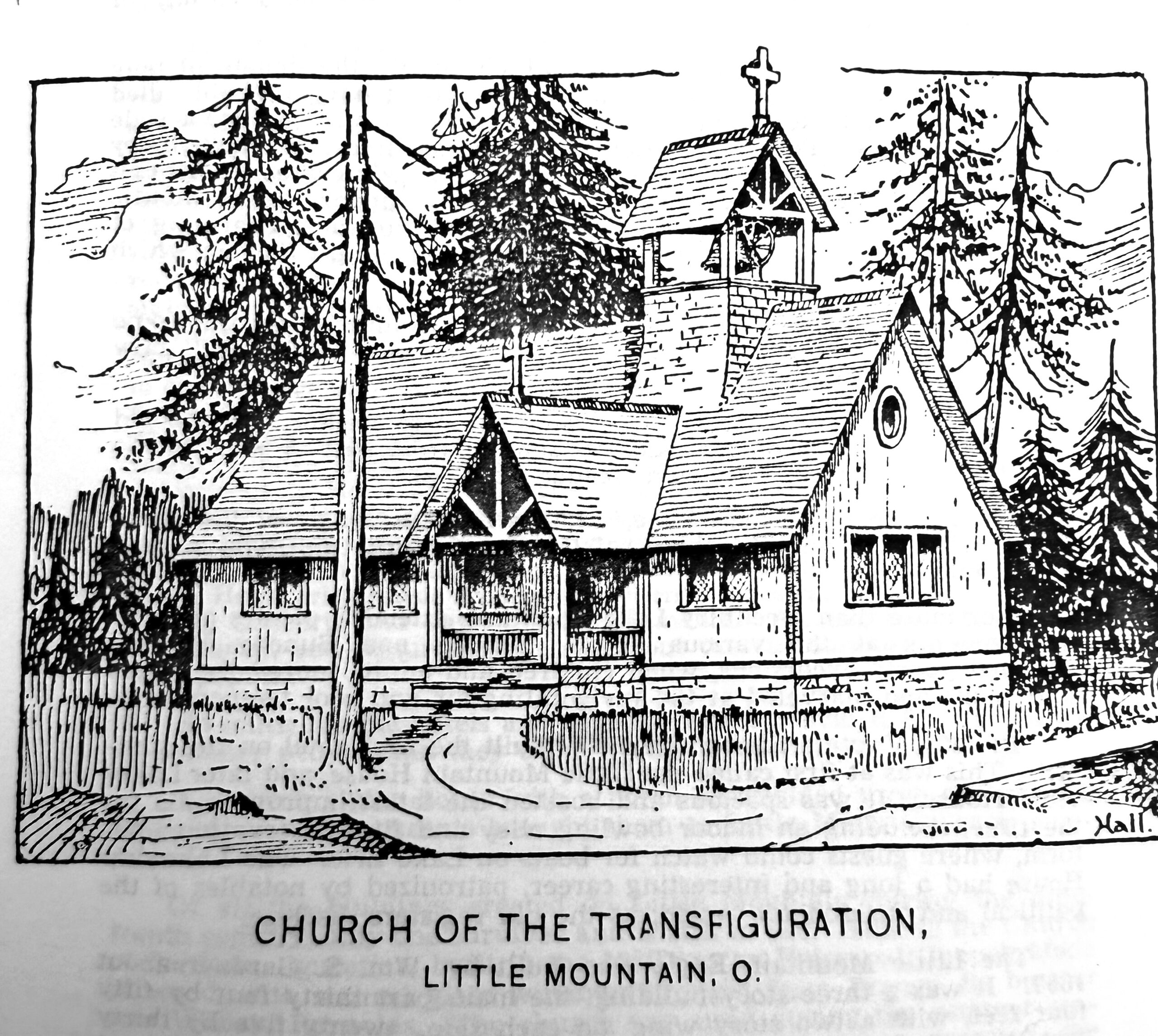
Bishop Leonard and Mrs. Garfield, inspired to find a use for the little church at Salida Beach, thought to move the church to the Kirtland Hills area. In the fall of 1928, Mrs. Irving C. Bolton, Mrs. Elton Hoyt II, Mrs. Allen C. House, and Mr. Irving C. Bolton visited the church and were enthusiastic to have it moved to Kirtland Hills. This led to a petition, largely comprised of the women of the community, to the Episcopal Diocese of Ohio requesting the transfer of the church, 35 signatures in all. Mrs. Fayette Brown suggested beautiful area along the Chagrin River (Baldwin Road) belonging to Mrs. Harry W. King. Mrs. King donated this property, which included apple trees, some of which still stand today.
After the required funds were raised by the Subscription Committee, which included Lawrence Hitchcock, Fayette Brown, Irving C. Bolton, Elton Hoyt II, Claude Peck, and S. Livingston Mather, the chapel was moved again by horse and wagon to its present location. The paneling on the walls of the Chapel, the steeple, the entrance porch, sacristy, robing room, altar rail, and sanctuary rail were all designed by architect Edward G. Reed.
The name, “St. Hubert,” was chosen because he is the Patron Saint of the hunt, the horse, and the hound. St. Hubert’s Chapel was dedicated by Bishop Leonard on June 2, 1929. Services originally were held at an hour when the congregation might ride to the church and then continue their ride until they returned home for a customary large Sunday dinner.
Reverend James S. Johnston, who also assisted with the formation of St. Andrew’s Church, came to St. Hubert’s from Grace Church in Willoughby in 1955. Originally, services were held only in the summer; but in 1972 year-round services were begun, and continue today.
The building of the former East Shore Unitarian Universalist Church on Center Street is one of the two estate mansions, identical in size, built by Colonel Frank A. Scott in the 1920’s. Colonel Scott, also a former mayor of the Village in later years, chose to emulate a style of architecture found in the Cotswolds of England when building his home. This building was originally called “Greystone Manor,” and was an authentic reproduction of a typical 16th century English Tudor Manor House. The building became available after the opening of the I-90 freeway, which was located perhaps too close to the manor house for comfort. The small but growing congregation was able to purchase Greystone Manor with the help of Thomas and Ethel Peterson of the First Unitarian Church of Cleveland. The congregation moved into this building in 1961. The congregation sold the building and property to a private owner in 1996. Sadly, this building was underutilized and largely sat vacant for a number of years. As of the time of this update (March, 2026), this building has been identified for demolition by the current owner of the property.
St. Andrew Episcopal Church on Little Mountain Road was admitted as an organized mission of the Diocese of Ohio in January 1958 and was granted permission to buy Village land on Little Mountain Road by Council. It was incorporated on May 5, 1959. The church building was completed and dedicated on October 23, 1960, after the congregation spent years meeting in living rooms, at the Mentor Christian Church, and at the Pythian Castle in Mentor. St. Andrew continues to hold regular services.
“The Field” – Baldwin and Chillicothe Roads
At one time, the Village owned several houses. One of these was the “Cole House” on Chillicothe Road, which was built by Alfred Morley around 1870. The Cole House stood south of Chillicothe Road, near the boundary between Kirtland and Kirtland Hills. It was renovated by Council in 1947 and was razed in 2000.
The “Hazeltine House” stood on Baldwin Road, on the other side of the field, near the present-day bridge that leads into the Sanctuary development. It was built by John G. Hazeltine in the 1860’s. The Hazeltine House was sold to. Jerome T. Osborne. It has also since been razed.
On May 21, 2007, Village Council authorized the mayor to grant a conservation easement of this Village land, consisting of fifty-three acres, to prevent any use of the property that would impair or adversely affect the conservation values of the property, including agricultural uses. This conservation easement is held by the Holden Arboretum. The Field is leased to a local farmer who typically raises corn and soybeans in alternating years. This agricultural setting greatly adds to the pastoral beauty of the Village and is often frequented by deer, fox, and wild turkeys. Occasionally, one can spot a bald eagle flying overhead, as a large bald eagle nest sits on farm property on the north side of Chillicothe Road, east of Center Street.
Across from “the Field,” the Kingwood Dairy once stood on Chillicothe Road just west of the Route 615 intersection. Apparently, Sealtest produced cream there at one time. Lockie-Lee then used it as a bottling plant, and the old farmhouse is now owned by the Church of Jesus Christ of Latter-Day Saints.
Gravity Hill – King Memorial Road
“Gravity Hills” exist all over the world, providing an optical illusion where a downhill slope appears to be an uphill slope – or vice versa- due to the surrounding topography. Ohio’s only documented “Gravity Hill” is located on King Memorial Road north of the intersection of Little Mountain Road.
This phenomenon was featured on “That’s Incredible” on ABC-TV filmed on location in the spring of 1980, featuring Kirtland Mayor Mario Marcopoli. ABC Studios in Los Angeles contacted local officials and asked for someone with “a knowledge of surveying” be there to evaluate the site. Mayor Marcopoli, an engineering instructor at Lakeland Community College in Kirtland, was a logical choice.
“We established a grade in the center of the road and found that it actually sloped down rather than up,” Marcopoli said in a News-Herald article from April 28, 1980. “It’s merely an optical illusion.” It was also noted that no one has been able to explain just exactly what makes the hill an illusion. Leon Bibb from News Center 5 later poetically reported on the Village’s “Gravity Hill” phenomenon in 2014 (available on YouTube). Kirtland Hills’ “Gravity Hill” is also featured in the book, Weird Ohio- Your Travel Guide to Ohio’s Local Legends and Best-Kept Secrets, although they mistakenly note that this phenomenon is in nearby Mentor, Ohio.
Hanna Estate- “Hi-Lo (Hilo) Farm”
The story of Leonard Hanna’s Hi-Lo farm and estate on Little Mountain Road is an interesting one as a portion of it traces its origins to Kent, England, in the 1400’s.
The Hanna family was one of Cleveland’s wealthiest. Its fortune was based on coal, iron ore, and Great Lakes shipping interests of Marcus A. Hanna and Co., then known as the Hanna Mining Company. Leonard C. Hanna, Jr. was a philanthropist who gave nearly 100,000,000 dollars to Cleveland’s cultural and charitable institutions.
Originally, Hilo Farm was first settled in 1814 by Levi Smith. Leonard C. Hanna purchased 316 acres of this property in 1924, intending for it to be a summer home. Hanna hired architects Derric & Gambler to build a country estate replicating a fifteenth-century English Tudor village. Hanna named the estate “Hi-Lo” after his favorite poker game.
In 1945, Hanna saved a historic Tudor house, which dates to 1472, from demolition by having it moved to Hilo Farm, reassembled, and enhanced with two additional wings. This historic house originally made its voyage to America in 1923 with two other stone homes when the John Wanamaker store in Philadelphia arranged to send a buyer to England to purchase, disassemble, and import, three stone houses.
The house had later served as the guest house on the estate of Edmund S. Burke on County Line Road in Hunting Valley prior to making its home in Kirtland Hills. Burke was a wealthy Cleveland industrialist who later became the Chairman of the Fourth Federal Reserve District. Burke had the house moved from Philadelphia and reconstructed in 1925 at that location by renowned stonemason George Brown.
Hilo Farm included a huge pool and pool house, covered bridge (the only covered bridge in Lake County), guest houses, kennels, caretaker’s house, sheep barns, and gate house, all of which were constructed locally. Most of these buildings faced Little Mountain Road.
Hanna maintained an apartment in New York and was friends with many sports figures, actors, and writers. One of his closest friends was Cole Porter, a classmate from Yale. Cole Porter is said to have written “Anything Goes” while visiting Hilo Farm.
In addition to Cole Porter, famous visitors to the Hanna Estate included Eleanor Roosevelt, Humphrey Bogart, Gene Tunney, Gloria Swanson, and Joan Crawford. There is a story that one of Hanna’s Weimaraner dogs accidentally swallowed a large diamond earring that belonged to Miss Crawford. Needless to say, she was extremely upset until it was recovered from the dog pen the next morning!
Some families in the Village can probably remember swimming in the Hanna pool, as he often allowed neighbors to use it on Sunday afternoons.
Following Hanna’s death in 1957, the estate was subdivided by then-owner Gerald Wearsch and modern homes were built on it. The original Hi-Lo Farm was drastically reduced by I-90, but the original gate house and its outbuildings have been restored and still can be seen from Little Mountain and Hart Roads. The original house, circa 1472, is still privately owned.
Holden Arboretum
With thousands of acres of land in Kirtland and Kirtland Hills, the combined holdings of Holden Arboretum, Cleveland Botanical Garden, and Leach Research Station constitute a magnificent array of formal gardens, old growth forests, and the stunning natural beauty of NE Ohio. The Arboretum was founded from a trust left by Albert Fairchild Holden in honor of his daughter, Elizabeth, who passed away in 1908 at the age of 12. At the time of his death at age 46 in 1913, Mr. Holden was President of the Island Creek Coal Company. He left an outstanding collection of minerals to the Mineralogical and Geological Museums at Harvard University.
Albert Fairchild Holden originally planned to leave his estate to benefit the Arnold Arboretum of Harvard University, but his sister, Roberta Holden Bole, convinced him that Cleveland needed an arboretum, too. Sites in both Bratenahl and Lake View Cemetery were originally considered, but neither worked out.
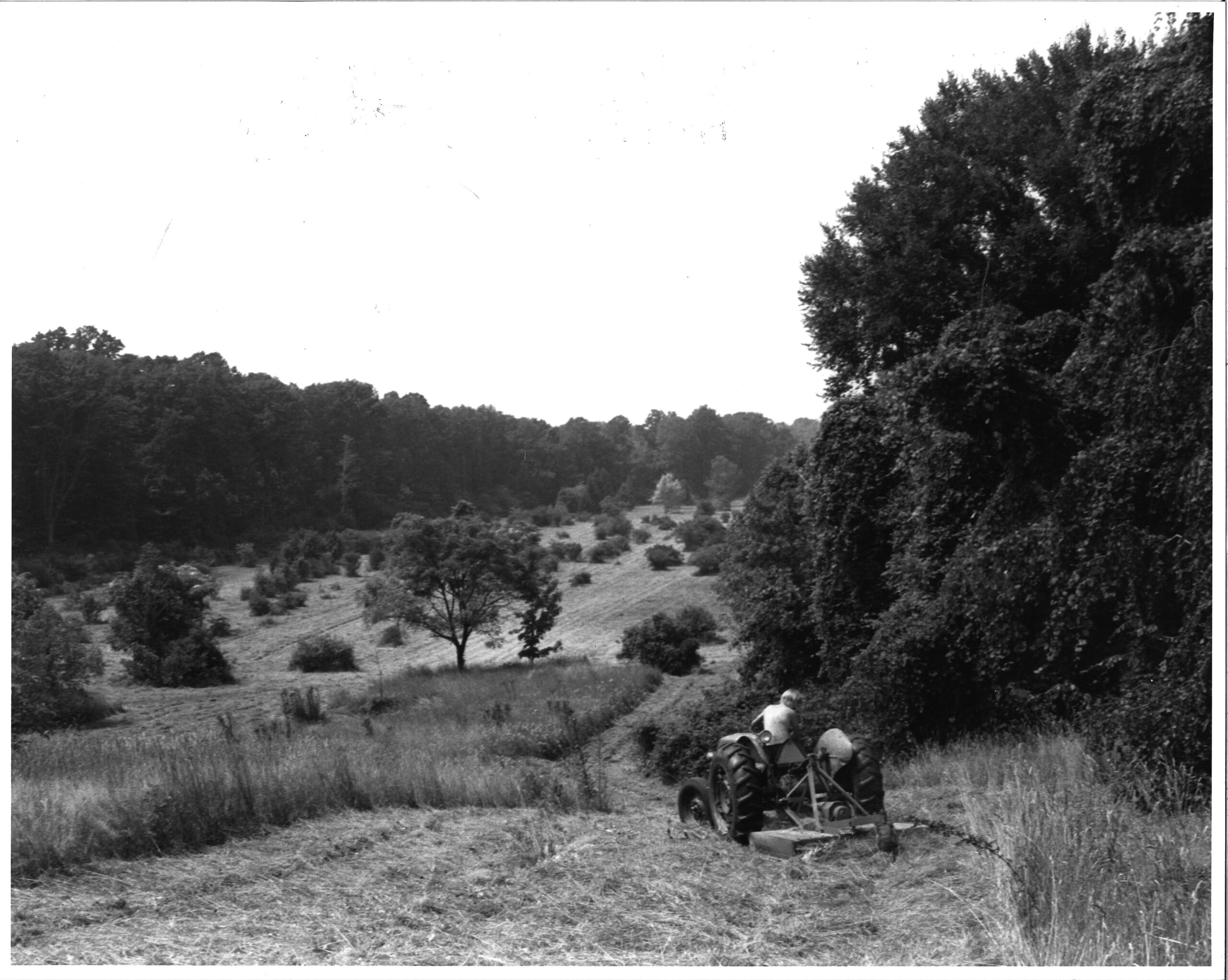
In 1931 Roberta and her husband, Benjamin Patterson Bole Sr., contributed 100 acres of land in Kirtland Township that remains the heart of the Holden Arboretum. It was administered by the Cleveland Museum of Natural History through a special Board of Control until the two institutions formally split in 1952. Mr. Holden’s daughters, Mrs. R. Henry Norweb and Mrs. Katherine Holden Thayer continued an active interest in the new Arboretum and the Holden family remains to this day among its most loyal supporters.
The Holden Trust serves as permanent endowment for the Arboretum. In 2014, Holden Arboretum merged with Cleveland Botanical Gardens to become Holden Forests & Gardens as they pursue a common mission to “connect people with the wonder, beauty, and value of trees and plants, to inspire action for healthy communities.” These organizations are also supported by contributions of members, donors, and business partners.
Hula Road
Hula Road, two-tenths of a mile east of Booth Road, once connected Baldwin and Sperry Roads. Nicknamed the “Hula Loop”, it was named for James Hula and was abandoned in 1929.
Riverside Schoolhouse #2 – Baldwin Road
The one-room schoolhouse at the corner of Booth and Baldwin Roads was built in 1894. It was called Riverside School, and classes were held there until 1920.
The building stood vacant for several years, until Leonard C. Hanna, Jr., the owner of the building, allowed the Village Council to meet there as it and the surrounding property had been absorbed into Hilo Farm after it ceased operating as a school. Thus, the schoolhouse served as the Village Hall until the current facility was built on Chillicothe Road in 1952.
Minutes of a 1940 Council meeting show that members discussed installing electric lights and a telephone in the schoolhouse for the use of the police department during the winter months.
After 1952, the schoolhouse once again stood vacant until it was purchased and remodeled into a home for the Anthony Ocepek family. Mr. Ocepek donated the house and property in 1988 to Lake Metroparks.
The Riverside Schoolhouse is now known as the Children’s Schoolhouse Nature Park, and is still owned and operated by Lake Metroparks. The facility is dedicated to sharing Lake County’s natural heritage with children and offers a variety of programming for small groups during the year.
Sanctuary Development
In March of 1988, the Humphrey family sold 552 acres of land that would eventually become “the Sanctuary” of Kirtland and Kirtland Hills to Total Design Enterprises Inc. (TDE) of Willoughby. Sunrise Land Co. (Sunrise), the real estate division of Forest City Enterprises, bought a 50% share of the property from TDE in October, 1988. Sunrise would later buy the entire project from TDE in 1990.
Once the Humphrey property was sold and development was imminent, the village took steps to protect as much of the natural beauty as possible. The village also hired a planning consultant for ongoing guidance and control of the Sanctuary design. The development would include paved streets and road signs that would match those already in the village. Home designs and landscaping would also need to pass “stringent” architectural review.
In April of 1989, the F.C. & Z Company, which comprised of both TDE and Sunrise Development Co., released plans to develop approximately 350 acres of land in Kirtland Hills for a maximum of 62 five-to-eight-acre homesites (third and fourth phases would add 200 acres in Kirtland). At the time, there were only 185 households in the village, so the Sanctuary, when complete, would add another third of the village’s population. Prior to that, the most recent development was on Kingwood Drive, where 13 homes had been built between 1978 and 1989.
Of the project, the developer shared that the topography was “fantastic,” as three or four ravines cut through the area like “fingers,” similar to the Holden Arboretum, which is nearby. Robert Dyer, Jr. of the Sunrise Development Co. shared with the Cleveland Plain Dealer that, while the topography made the design tough, “[e]verybody’s got a ravine in their back yard; you feel like you’re in the middle of nowhere.”
Construction began in the spring of 1989, including clearing and grading. The developer intended the Baldwin Road entrance to “look like a road that’s been there for 100 years.” The trees lining this entrance were relocated from other areas of the property, creating a natural canopy. The original bridge featured wooden guardrails and stone abutments, built over the East Branch of the Chagrin River, which winds through the property.
Unfortunately, road salt and time were not kind to this lovely bridge, and it started to fail a little over 30 years later. The original bridge, built by the developer, was removed in June of 2023, and a new bridge was erected in its place by the county. The new bridge opened to the public on October 23, 2023.
Shadybrook Farm
Arthur D. Baldwin, the son of Hawaiian missionaries, and Reba Williams Baldwin, a daughter of a founder of Sherwin-Williams Paint Company, established Shadybrook as a summertime residence for their family early in the 1900’s.
In 1926, the present house was built on the foundation of an earlier frame house which had· burned. It was designed by Abram Garfield, son of President Garfield. Formal gardens, a polo field, and extensive grape arbors all represented the interests of the Baldwins.
Shadybrook was a working farm, originally consisting of 543 acres and three on-site farm families. In 1955, the Baldwin children sold Shadybrook Farm to the Holden Arboretum. The land was used as an important part of the Arboretum’s planting and management programs. The Arboretum rented the house to a Laymen’s Retreat Association for about twenty-five years, until the Lake County History Center acquired a long-term lease for the house and fourteen surrounding acres in 1983. Ultimately, the Lake County History Center moved to its current location in Painesville in 2008. The home is currently privately owned.
***
References and Sources of Information
“About Holden Forests and Gardens- Our History” Holden Arboretum, https://holdenfg.org/about/history/ (Accessed April 25, 2026).
Ahlstrom, Janice Mather. “The Little Mountain Story”, The Historical Society Quarterly, Lake County, Ohio, Vol. 3, No.4, October, 1961.
“A Journey Through Time on Little Mountain.” The Holden Arboretum, 1992.
A Record of the Revolutionary Soldiers Buried in Lake County, Ohio: With a Partial List of Those in Geauga County and a Membership Roll of New Connecticut Chapter, Daughters of the American Revolution. Heritage Books, Inc, 1999.
Andrews, Alice B. “Visiting a Realm of Cleveland Aristrocracy” (photocopy of newspaper article-origin unknown).
“An opportunity for change is missed,” The Cleveland Plain Dealer, February 17, 1990.
“Antiques” June, 1934 issue. A current version of rural early English-the country home of Leonard C. Hanna, Jr., near Cleveland, Ohio. (other information unknown).
“Blish Road (Verbsky Farm- Reynolds) Cemetery,” Lake County Genealogical Society Painesville, Ohio, https://www.lcgsohio.org/cemeteries/mentor-cemeteries/blish-road-verbsky-farm-reynolds-cemetery/ (Accessed March 28, 2026).
“Burial Plot of Pioneers One of Smallest in State” (photocopy of newspaper article–origin unknown).
“Cemetery at King Memorial Inscriptions–copied August, 1927” (photocopy from Lake County Historical Society).
“The Cleveland Museum of Natural History, From Humble Shack to Venerable Institution,” Cleveland Historical, https://clevelandhistorical.org/items/show/41#:~:text=Many%20other%20societies%20also%20used%20Case%20Hall%2C,leader%20Jared%20Kirtland%20was%20also%20an%20Arkite (Accessed April 25, 2026).
Cleveland and Its Environs, Leonard C. Hanna, Jr. information (other information unknown).
Copies of old ads for Little Mountain Hotels (origins unknown).
Corrigan, Mary Lou. “Little Mountain–Vacation Magnet” from the “Lake County News Herald” Tuesday, June 26, 1977 page 18.
East Shore Unitarian Universalist Church brochures (available from the Church).
Encyclopedia of Cleveland History, Case Western Reserve University, “Jared Potter Kirtland,” https://case.edu/ech/articles/k/kirtland-jared-potter (Accessed April 25, 2026).
Engleking, Jennifer Boresz. “Hilo Farm,” Hidden History of Lake County, Ohio, pp. 52-57. The History Press, 2021.
The Evening Journal-Tribune, “Commissioners at Hearing on New North-South Pike,” October 18, 1955.
“Famed Little Mountain Resort Drew Vacationers Like a Magnet,” The News-Herald, Wednesday, June 28, 1978.
Goulder, Grace. “Little Mountain, Once Famed for Hotels and Hygenic Air, Now Taken Over By Big Estates” from “Ohio Scenes and Citizens”, Cleveland Plain Dealer Pictorial Magazine, May 22, 1949.
“Greystone Manor,” The Cleveland Memory Project, https://clevelandmemory.contentdm.oclc.org/digital/collection/press/id/16843/ (accessed March 30, 2026).
History of Geauga County, The 1953 Leonard C. Hanna, Jr. information, page 720 (other information unknown).
Hitchcock, Elizabeth G. “Kirtland Hills Village, 1926-1976 from Council Minutes.
Hitchcock, Elizabeth G. “Little Mountain” April, 1988 (other information unknown).
Hitchcock, Elizabeth G. “St. Andrew’s From the Very Beginning”.
Hitchcock, Elizabeth G. “The Travels of St. Hubert’s Chapel” from the “Lake County Historical Society Quarterly”, Vol. 15, No.4, November, 1973.
Holden Arboretum 1987 Annual Report, page 3 and 5.
“Homes”-Jacobethan Section. Leonard C. Hanna, Jr. information (other information unknown).
“Kingwood Farm,” “Historic Country Estates in Lake County,” Wikipedia https://en.wikipedia.org/wiki/Historic_country_estates_in_Lake_County,_Ohio (accessed March 30, 2026).
Lake County Historical Society printouts–available from Lake County History Center.
“Little Mountain- Home to titans of industry and towering pines,” Holden Arboretum, https://holdenfg.org/attractions/holden-arboretum/little-mountain/ (Accessed April 25, 2026).
Map of Locations in Kirtland Hills, prepared April 30, 1988.
“Marcoli to explain Mystery Hill Secret,” The Lake County News-Herald, Monday, April 28, 1980.
McConnel, Ann. “St. Hubert’s History 1893- 2018.”
National Cyclopedia Leonard C. Hanna, Jr. information, page 74 (other information unknown).
“Old Stocking House, Once Exclusive Resort, Yields to March of Progress”, 1941. Photocopy of newspaper article (other information unknown).
Podolak, Janet, “…While One Grave Has Historical Significance”, “Lake County News Herald” June 29, 1982.
Record of the Council of Kirtland Hills Village, September 17, 1926 – February 13, 1932.
“Sanctuary Drive Bridge Project in Kirtland Hills to begin,” The News Herald, June 9, 2023.
Springfield Daily News, June 14, 1929, “Cougar Hiding in Underbrush Near Cleveland.” Akron Beacon Journal, June 14, 1929 “Ohio Village Agog Over Roving Beast- Youth Reports Running Afoul of Something that Looked Like a Panther.”
Steed, Mildred, “John Reynolds was New York Judge”. April 19, 1975.
That’s Incredible,”Gravity Hill,” https://www.youtube.com/watch?v=rc8vUSY4RP8 https://www.youtube.com/watch?v=rc8vUSY4RP8
“The Sanctuary – Luxury Homes to Feature Cliffside Estates,” The Cleveland Plain Dealer, Sunday April 16, 1989.
Village of Kirtland Hills Newsletters.
Village of Kirtland Hills – “Background of our Fiftieth Celebration,” October 8, 1976.
“Vote on Incorporation – Residents of Kirtland Hils Vote Saturday on the Project,” The Cleveland Press, August 11, 1926.
“Where he Roamed- House on Kirtland Hills Estate affords Glimpses into Legendary Life of Hanna,” News-Herald, Sunday July 13, 2008.